

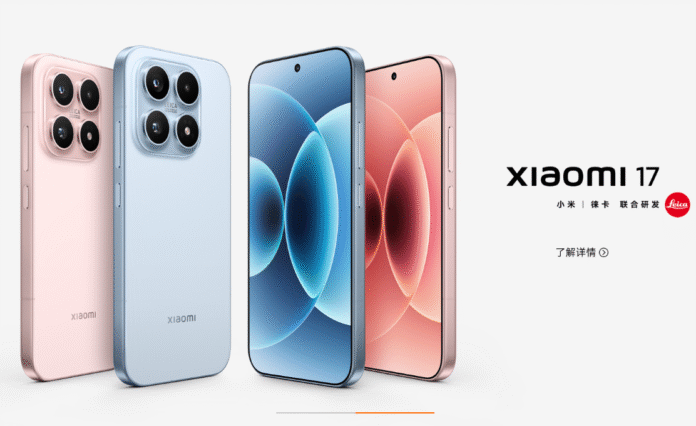
📌 Updated 11 August 2026: new information published by Digital Chat Station brings major details on the Xiaomi 18: the choice of 5 colours, the exact architecture of its 2 nm processor, and official comments from the brand on the increase in its launch price.
While the global trend is pushing towards ever larger and heavier phones in order to house big batteries, Xiaomi continues to refine its compact range. The latest revelations around the Xiaomi 18 describe a particularly well-rounded device, combining a 6.4-inch screen, a 7,200 mAh battery and a camera set-up inherited directly from the Pro versions.
A clear price increase, and the brand’s explanation
This is one of the major takeaways from these leaks: the pricing structure shifts noticeably compared with the previous generation. In China, the Xiaomi 18 would start above 5,499 yuan for its entry-level model, against 4,499 yuan when the Xiaomi 17 launched. That 1,000 yuan increase represents a significant step up.
Faced with this anticipated rise, Lu Weibing, president of the Xiaomi group, stepped in directly to explain the industrial reasons behind it. He points to the global surge in supply costs for memory components (RAM and Flash storage). According to his forecasts, this pressure on the production chain should keep prices high at least until the end of 2027, possibly 2028. This is therefore a structural trend that will affect the entire mobile market.
It is worth remembering that a Chinese price does not translate directly into euros. Local taxation, shipping costs and import margins are all added to the final European price. Official pricing for our market will be confirmed at the European announcement.
5 official colours and a faithful design
Visually, the Xiaomi 18 keeps the brand’s design language. The rear panel carries the square camera module positioned in the upper left corner, in direct continuity with the Xiaomi 17. Carrying over this format brings a practical benefit: the overall silhouette stays familiar, and accessory ranges retain a great deal of consistency.
The novelty lies in the variety of finishes on offer. The flagship will be available at launch in 5 shades:
- Black (matte finish)
- White
- Pink
- Blue
- Red
At the front, the device keeps a flat 6.4-inch screen at 2K resolution using SuperPixel technology. Ultra-thin symmetrical bezels help maintain a very manageable footprint, ideal for anyone after a high-end smartphone that can comfortably be used with one hand.
Snapdragon 8 Elite Gen 6: what the 2 nm process brings
On the main component, the Xiaomi 18 will be among the first phones on the market to carry the Qualcomm Snapdragon 8 Elite Gen 6 platform, built by TSMC on its 2 nm process.
The chip’s detailed architecture reveals choices geared towards power efficiency:
- Oryon CPU (2 + 3 + 3): two very high-frequency cores handle heavy tasks and gaming, while six secondary cores deal with background operations (notifications, syncing) without calling on maximum power.
- 16 MB of shared L2 cache: this buffer allows the processor to keep frequently used data within immediate reach, cutting day-to-day latency and improving overall interface fluidity.
- Adreno 845 GPU: handles graphics rendering and sustains the refresh rate.
- LPDDR5X RAM: guarantees fast switching from one app to another without pages reloading unnecessarily.
The 2 nm process combined with the 7,200 mAh battery (against 7,000 mAh on the Xiaomi 17) makes it realistic to target two days of real-world battery life in standard use, and even three days with moderate use.
Leica camera block: moving to a dual 200 MP setup
The camera subsystem changes significantly. Xiaomi sets aside the previous model’s triple 50 MP arrangement in favour of a dual 200 MP configuration designed in partnership with Leica.
The set-up consists of a main wide-angle sensor and a 3X periscope telephoto lens at 200 MP. This is the first time a standard model in the range inherits a periscope-structured telephoto, a piece of equipment reserved until now for the Pro variants.
In practice, a 200 MP resolution on the optical zoom leaves plenty of room for framing. It becomes possible to crop an image after the shot while retaining excellent on-screen sharpness.
Premium equipment and design trade-offs
To fit a 7,200 mAh battery inside a compact 6.4-inch chassis, the engineers chose not to include a secondary screen on the back, unlike the Pro models. All of the internal volume saved has been reallocated to battery capacity.
The rest of the spec sheet maintains high-end standards:
- Ultrasonic under-display fingerprint reader: ensures fast unlocking, including with damp fingers, outperforming the accuracy of traditional optical sensors.
- Water resistance: IP68 is now the norm in this segment, and manufacturers increasingly add IP69, which covers high-pressure water jets. The Xiaomi 18’s exact rating remains to be confirmed.
- Fast charging: support for 100W wired charging along with wireless charging.
Xiaomi 18 full specifications
| Component | Expected specifications |
|---|---|
| Display | Flat, 6.4-inch, 2K resolution, SuperPixel panel |
| Processor | Qualcomm Snapdragon 8 Elite Gen 6 (2 nm TSMC) |
| CPU / GPU | Oryon 2+3+3, 16 MB L2 cache, Adreno 845 |
| RAM | LPDDR5X |
| Camera | Dual 200 MP Leica (main + 3X periscope) |
| Battery | 7,200 mAh (against 7,000 mAh on the Xiaomi 17) |
| Charging | 100W wired + wireless charging |
| Biometrics / Water resistance | Ultrasonic fingerprint sensor, IP68 or IP69 |
| Colours | Black, White, Pink, Blue, Red |
| Estimated price (China) | From above 5,499 yuan |
| Launch | September 2026 (China) |
Xiaomi 18 or Xiaomi 18 Pro: which one to choose?
This year, the gap between the standard model and the Pro version narrows considerably:
- Battery advantage to the standard model: the Xiaomi 18 carries 7,200 mAh against 7,000 mAh on the Pro, benefiting from the space freed up by the absence of a rear screen.
- Secondary rear screen: remains exclusive to the Pro version.
- Ultra-wide sensor: the Pro keeps a dedicated ultra-wide module, whereas the standard model concentrates its camera architecture on the wide-angle and 200 MP periscope telephoto pairing.
For users who prioritise a compact feel in the hand, battery longevity and photographic zoom, the standard model stands out as a very rational option. Full details on the Pro version are available in our dedicated article: Xiaomi 18 Pro, the compact monster with two 200 MP sensors.
In summary
Expected in September 2026, the Xiaomi 18 is shaping up to be a key model this autumn for anyone looking for a high-performing compact format without compromising on battery life or camera quality.
You will be able to find the device on our shop as soon as it becomes available. While you wait, you can browse our full range of Xiaomi smartphones, along with dedicated accessories such as Xiaomi cases and official Xiaomi chargers.

