

📌 Updated 11 August 2026: new information cross-checked with suppliers and leaker Digital Chat Station sharpens the Vivo X500 Pro’s spec sheet: a compact 6.37-inch BOE display refreshing at 144 Hz, a Dimensity 9600 Pro built on a 2 nm process, and a 50 MP Sony sensor with LOFIC technology. All the details have been added below.
While Vivo wraps up the international rollout of its previous ranges, the brand is actively preparing to renew its high-end catalogue in China. For this new generation, the manufacturer is choosing to skip the “X400” naming and jump straight to the Vivo X500 series. That commercial decision comes down to tetraphobia, a superstition widespread across several Asian countries where the pronunciation of the number 4 is very close to the word “death”.
Within this family of four main models (X500e, standard X500, X500 Pro and X500 Pro Max), the Vivo X500 Pro looks like a particularly targeted proposition. It speaks to users after a phone with contained dimensions but no compromise on hardware. This model could also be sold in some markets under the name Vivo X500 Pro Mini.
Design and display: the compact LTPO 144 Hz achievement
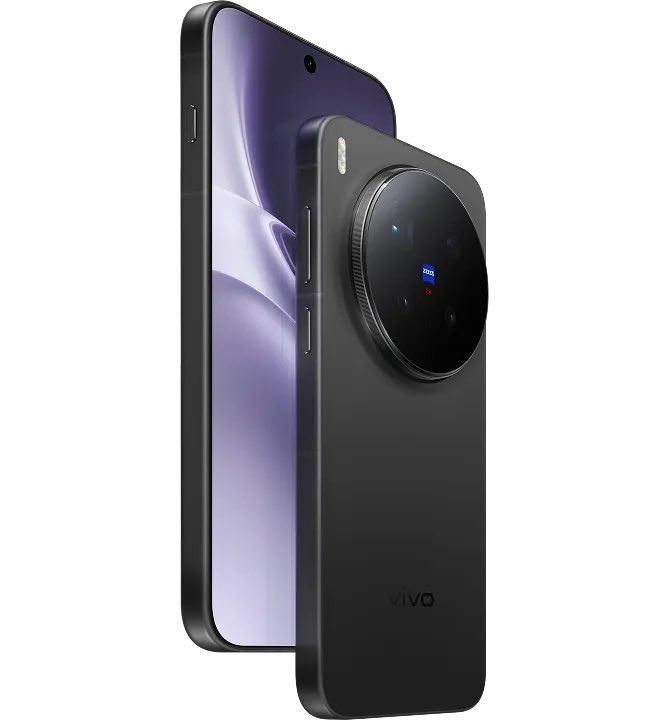
Aesthetically, the X500 series marks a clear visual split between models. While the standard Vivo X500 would adopt a camera block offset into the upper left corner, the Vivo X500 Pro would carry an imposing circular module centred on the back of the device. The chassis would be built around a completely flat display with generously rounded corners, dropping the curved edges of previous generations.
The display would be an OLED panel supplied by BOE, measuring 6.37 inches. This compact format would offer a 1.5K resolution of 2,800 × 1,260 pixels and a peak brightness quoted at 2,600 nits, guaranteeing perfect legibility outdoors in strong sunlight. The panel would rely on LIPO encapsulation (Low-Injection Pressure Overmolding), delivering extremely thin symmetrical bezels on all four sides.
Two technical features bring a direct benefit to everyday use:
- LTPO adaptive refresh from 1 to 144 Hz: the panel would adjust its frequency in real time depending on what is on screen. It would climb to 144 Hz for maximum fluidity during supported gaming sessions, then drop automatically to 1 Hz when displaying a still image or a page of text. That adaptive behaviour saves a considerable amount of battery across the day.
- PWM dimming at 1,920 Hz: in low light or at night, high-frequency pulse-width modulation would reduce screen flicker at low brightness. This technology helps avoid eye strain and headaches in people sensitive to OLED dimming.
Processor and architecture: the Dimensity 9600 Pro on a 2 nm process
Under the bonnet, the Vivo X500 Pro would mark an important difference from the standard model. Where the base version would use a Dimensity 9600 built on a 3 nm process, the Vivo X500 Pro would step up to the brand-new MediaTek Dimensity 9600 Pro SoC.
Built by TSMC on its cutting-edge 2 nm process, this chip would deliver a major efficiency gain over previous architectures. A finer process makes it possible to hold high clock speeds under heavy load while limiting both heat output and power draw.
The phone would run the OriginOS 7 interface, developed on an Android 17 base. Software optimisation combined with the processor’s headroom would guarantee smooth support over several years, both for heavy multimedia work and for the AI processing built into the system.
Camera: choosing a 50 MP LOFIC sensor and a 64 MP periscope
On the photography front, Vivo would make a deliberate engineering choice by not chasing a megapixel war on the Pro version. The main camera would rely on a particularly well-balanced triple sensor set-up:
- 50 MP main sensor (1/1.28-inch) with LOFIC technology
- 64 MP periscope telephoto at 85 mm (dedicated to portraits and macro)
- 50 MP ultra-wide
The presence of LOFIC technology (Lateral Overflow Integration Capacitor) on the main sensor is the major evolution in this camera block. In a traditional sensor, photosites saturate quickly with light when shooting into strong backlighting or under harsh night-time illumination, creating completely blown-out white areas. The LOFIC structure makes it possible to redirect and store the excess electrons generated by highlights into a lateral capacitor. In practice, this technology preserves detail in the brightest parts of an image without darkening the rest of the scene, delivering exceptional dynamic range.
The 64 MP periscope telephoto would adopt an ideal focal length of 85 mm. That focal length is the gold standard of portrait photography, giving a natural rendering of the face without perspective distortion, along with a very progressive background blur. This module would also support telephoto macro photography, capturing very close-up detail without casting the phone’s shadow over the subject.
Unlike the Pro Max model, the X500 Pro would not call on a 200 MP sensor. This is a deliberate decision, aimed at keeping a more compact optical structure so as not to unbalance the phone in the hand.
Battery and endurance: the 7,000 mAh challenge in a measured chassis
Power management is the major challenge Vivo’s engineers face on the X500 Pro. Fitting a high-capacity battery into a compact 6.37-inch chassis means optimising every cubic millimetre inside, especially with a substantial periscope camera block in the way.
The first prototypes measured on test lines would show real capacities between 6,500 and 6,600 mAh. Vivo’s development teams would, however, be actively pushing the density of their silicon-carbon cells to reach the symbolic 7,000 mAh mark on the final commercial version.
Should that target be validated for mass production, the X500 Pro would post battery life that is rare for a phone this size, going beyond two days of intensive use.
Release date and availability
Current reports agree on an initial launch for the Vivo X500 Pro in September 2026 in China. As usual, the manufacturer reserves the first announcement for its home market.
An international release remains on the agenda, however. Global variants of the phone have started appearing in international certification databases, which suggests a European arrival in the months following the Chinese announcement.
Vivo X500 Pro full specifications
| Component | Expected specifications |
|---|---|
| Display | Flat, 6.37-inch, BOE OLED 1.5K (2,800 × 1,260 px) |
| Display technologies | LTPO adaptive 1-144 Hz, 1,920 Hz PWM, 2,600 nits, LIPO |
| Processor | MediaTek Dimensity 9600 Pro (2 nm TSMC) |
| Operating system | OriginOS 7 on an Android 17 base |
| Main camera | 50 MP (1/1.28″, Sony LOFIC) |
| Telephoto | 64 MP periscope (85 mm, portrait and macro) |
| Ultra-wide | 50 MP |
| Battery | 6,500 to 6,600 mAh (7,000 mAh target, silicon-carbon) |
| Rear design | Centred circular camera module |
| Estimated release | September 2026 (China) |
Vivo X500 Pro or Vivo X500 Pro Max: which one to choose?
If you are hesitating between the two most ambitious models in the range, here are the key points to weigh up:
- Size and display: the X500 Pro goes for compactness with its 6.37-inch panel (1.5K), while the Pro Max targets fans of very large displays with its 6.85 inches (2K).
- Telephoto sensor: the Pro model banks on a very well-balanced 64 MP periscope (85 mm), whereas the Pro Max fits a giant 200 MP periscope sensor allowing far deeper crops.
- Battery life: the Pro targets 6,500 to 7,000 mAh in a small format, against a giant battery approaching 8,000 mAh on the Pro Max’s larger chassis.
For a detailed study of the large-format model, see our full article on the Vivo X500 Pro Max.
In summary
The Vivo X500 Pro is shaping up as one of the most complete compact phones of the year. By combining the power of a 2 nm process, a firm grasp of LOFIC camera technology and a battery oversized for its footprint, it answers precisely what users want when they are after performance without the bulk of large phablets.
You will be able to find the brand’s products as soon as they become available. While you wait for the European announcement, you can browse our Vivo smartphones section, along with dedicated protection such as Vivo cases and Vivo tempered glass.

